
Premonitions of a Major Market Top
I dropped out of the Phd Philosophy program at UC Davis to start Top Gun in 2006 in order to profit from the bursting of the housing bubble and the subsequent recession that I foresaw. Indeed, the market topped in 2007 and the S&P lost almost 40% in 2008. But that’s ancient history that many current participants have no memory of because they weren’t in the market back then.
What happened next is the context. The S&P bottomed below 700 in March 2009 and set off on the greatest bull market in history. 17 and a half years later, the S&P is at nearly 7,700. It’s been an epic run that has made many investors very wealthy. But there are signs that the good times may be coming to an end.

The current iteration of the bull market began in May 2023 when Nvidia (NVDA) released a stellar earnings report inaugurating the AI bull market. Like the Dot Com Boom of the late 1990s, the AI Boom has only accelerated. In fact, The Wall Street Journal ran a front page article last week showing that the capex to build out AI is the greatest investment boom in economic history.
While this has propelled the economy and the stock market to dizzying heights it is not without risk. As Jonathan Weil wrote in an excellent column in Monday’s WSJ, if the capex into AI starts to slow down that could shift the economy and the market into reverse (“How To Know When AI Boom Is Ending” [SUBSCRIPTION REQUIRED]).
While that has yet to transpire rising interest rates are starting to weigh on the market. The 10 year treasury yield broke out above 5% last Wednesday – and has not looked back. Rising interest rates increase the cost of new investment that requires borrowing, increases the carrying cost of debt when it is rolled over to the higher rate, makes treasuries more attractive relative to stock and increases the discount rate used to discount future earnings thereby reducing the intrinsic value of financial assets. In short, rising interest rates act as a sort of tightening on economic growth and the value of economic assets.

In addition to those two fundamental concerns, market internals are starting to show a concerning level of deterioration. While the cap weighted S&P is holding up, beneath the surface most stocks are breaking down. Jason Goepfert of Sentiment Trader tweeted this morning that while the S&P is within 1% of its all time high, 70% of its components are in a correction of at least 10%. The only other time that has happened in the last 30 years is in the run up to the Dot Com top in March 2000.

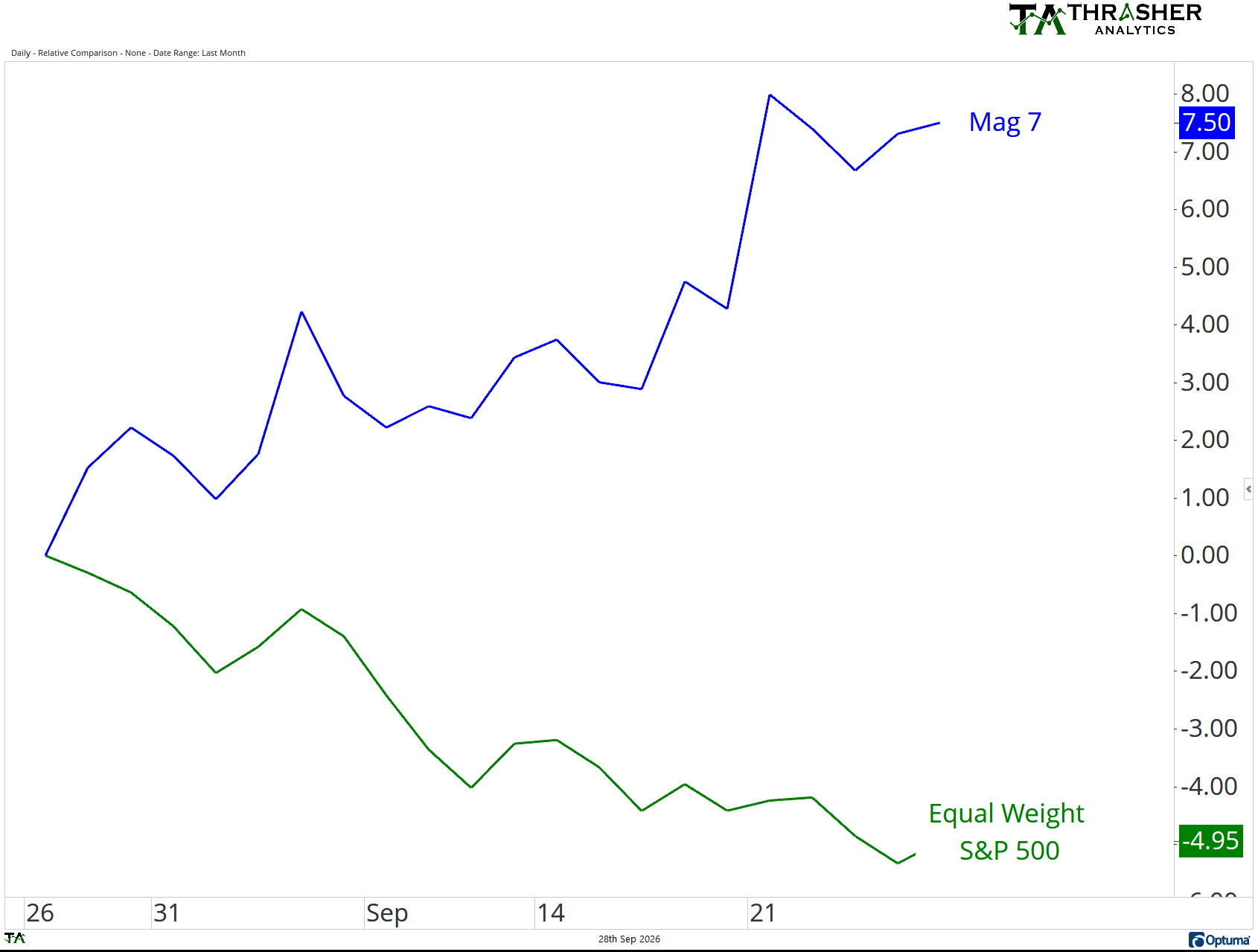
Only about 50% of S&P stocks are above their 200 DMA and new 52 week lows have been greater than 52 week highs for a number of days now. The Magnificent 7 are the only thing holding up the market cap weighted S&P 500 as most everything else has rolled over.
This exactly what happens at bull market tops. The classic paper on market tops is Paul Desmond of Lowry’s “An Exploration of the Nature of Bull Market Tops”. In that paper, Desmond reviews the market internals on the day the Dow Jones peaked in the 14 major tops from 1929 through 2007. What he found was that only a few stocks are at all time highs or within 2% of them on the day of the index’s high point. Surprisingly most stocks have already started to roll over into their own individual bear markets long before. Jesse Livermore noted the same thing in 1916 as described in Chapter 14 of Reminiscences of a Stock Operator.

In many ways the most important tell on market sentiment towards the AI bull is Oracle (ORCL). While ORCL is not of the size of The Magnificent 7 it is still one of the biggest stocks in the market with a market cap of about $400 billion. The reason ORCL is important is because it is the company making the biggest bet on AI relative to its size.
ORCL expects FY27 revenue to be at least $90 billion and it is forecasting $95 billion in capex. You read that correctly: ORCL intends to spend more than its entire FY27 revenue on capex to build out its AI infrastructure. It is going to borrow an enormous amount of money and be massively free cash flow negative in order to do so.
But the market is starting to sour on ORCL. You can see this in the chart above of the price of its 30 year bonds, their yield to maturity, the spread compared to government bonds and the price of credit default swaps to insure their debt. The increasing concern over ORCL’s debt shows that the market is becoming increasingly concerned about the AI boom.
For all of these reasons I believe the great bull market of 2009-2026 is on the verge of rolling over into an epic bear market the likes of which most current market participants have not seen before, are extremely complacent toward and are wholly improperly position for. Get your popcorn ready.

