Top Gun FP Client Note: The Long Awaited Correction
NOTE: Every week or two I write a Client Note for my clients. For a limited time, I am allowing non-clients to sign up and receive it at the same time as my clients. You can sign up at the top right hand corner of the website. I will also be posting the notes on my blog with a time delay from time to time.
Originally sent to clients April 17.
*****
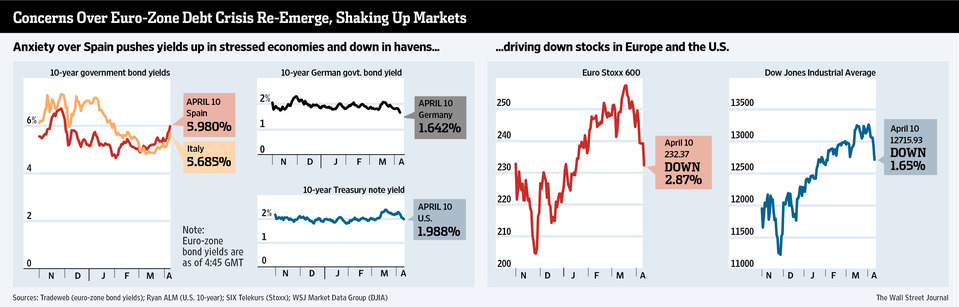
Stocks finally had the long awaited correction after the first quarter melt up. From Tuesday April 2nd through Tuesday April 10th, the S&P dropped 60 points (4%). That might not seem like a lot but it represents a 37% giveback of the year-to-date gains peak to trough. The correction in Europe started earlier and was significantly deeper amounting to 10% on the Euro Stoxx 600.
As highlighted in “A Preview Of 1st Quarter Earnings” (April 3), the two catalysts were concern about a weak 1st quarter earnings season as well as renewed fears of Europe’s sovereign debt crisis.
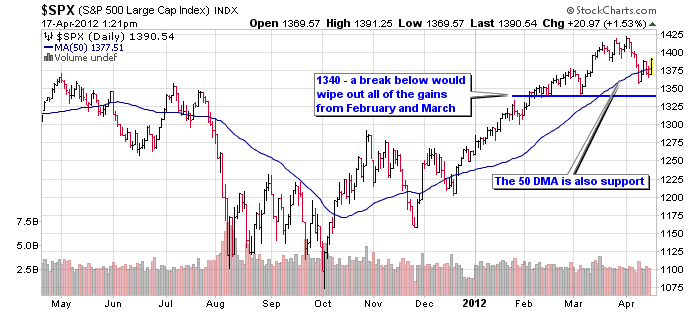
Technically, this is just a normal correction within a healthy uptrend. Markets don’t go straight up or straight down but have countertrend moves which restore equilibrium between the supply and demand for shares. Traders have keyed in on the 50 day moving average – currently at 1377 – as a source of support.
The representative view that this is a normal and healthy correction was perfectly expressed by Dave Zier, one of the top investment advisors in the country, and Larry Kantor, Barclays Head of Research, on CNBC last Tuesday.
The trend followers are also continuing to give the market the benefit of the doubt. Many of them seem to be focused on 1340. That level was first breached on the heels of the strong January Jobs Report on Friday February 3rd and has served as support since then. A decisive break would wipe out all of the gains from March and February.
As everybody knows by now, I am less sanguine. While I covered half of our large S&P short position last Tuesday to get ahead of bulls who would view the correction as a buying opportunity, I am using today’s rally to put it all back on plus a little extra for good measure.
*****
After keeping up with the indexes through February despite becoming increasingly bearish, March was a bad month for Top Gun:
March ’12 Returns
Top Gun: -7.76%
S&P: +3.13%
DJ Total: +2.94%
Contrary to what you might think, this was NOT primarily because of my bearish perspective on the overall market. 77% of the loss was attributable to a big hit taken by a stock in which we have an oversized position.
This was the second worst month in Top Gun’s history on both an absolute and relative to the market basis. The only worse month in terms of absolute returns was October 2008 (-12.19%). However, the S&P was down -16.83% that month. The only worse month relative to the market was July 2009 when Top Gun was down -3.58% while the S&P was up +10.56%.
Here are the returns for the 1st quarter:
1Q ’12 Returns
Top Gun: -0.64%
S&P: +12.00%
DJ Total: +12.54%
I will attach the performance chart to the next Client Note and it will be on the website within a week or so as well.
Greg Feirman
Founder & CEO
Top Gun Financial (www.topgunfp.com)
A Registered Investment Advisor
9700 Village Center Dr. #50H
Granite Bay CA 95746
(916) 224-0113
CALL NOW FOR A FREE INITIAL CONSULTATION!